
Music for Retail Stores: How It Works and What to Look For
Music for retail stores is one of those things that’s easy to ignore until it becomes a problem. A store goes silent because a player failed. A manager connects a personal phone and explicit lyrics play over the sales floor. Corporate has no idea what’s actually playing in any given location on any given day.
For single-location businesses, these can be minor annoyances. For chains managing dozens or hundreds of stores, they’re operational gaps—the kind that land on an Ops Director’s desk and stay there until someone finds a system that makes the problem go away.
It’s tempting to treat music as background noise that doesn’t warrant much attention—something closer to your HVAC system than your inventory management platform. But operators who pay attention to it find there’s real value to extract. Not because you’re manipulating customers with subliminal messages, but because you’re managing it the same way you manage any other system that touches every location: with visibility, control, and accountability.
To understand how retail music works today—and what to look for in a provider—it helps to understand how it got here.
The story of background music for retail stores started with Muzak. Founded in 1934, Muzak pioneered the idea that music could be used deliberately in commercial spaces—not as entertainment, but as an environmental tool designed to influence behavior. This was their innovation: recognizing that businesses would pay for music programmed specifically for commercial environments.
Their early approach was built on instrumental covers of popular songs, recorded in-house by studio musicians and distributed on tape. An operator would physically load and flip tapes to keep the music running. By the 1950s, Muzak had moved to longer-running tape systems and FM subcarriers. The music was programmed centrally and delivered to subscribers. Businesses had no say in what played—the catalog was limited, and every location across every customer on a given channel heard the same thing at the same time.
They also used a concept called “Stimulus Progression”: blocks of instrumental music that gradually increased in tempo, designed to subtly boost worker productivity. It was a one-size-fits-all model, and it worked—because the alternative was silence or dealing with radio commercials.
The Muzak Era: One Sound for Everyone

The Muzak Era: One Sound for Everyone
The story of background music for retail stores started with Muzak. Founded in 1934, Muzak pioneered the idea that music could be used deliberately in commercial spaces—not as entertainment, but as an environmental tool designed to influence behavior. This was their innovation: recognizing that businesses would pay for music programmed specifically for commercial environments.
Their early approach was built on instrumental covers of popular songs, recorded in-house by studio musicians and distributed on tape. An operator would physically load and flip tapes to keep the music running. By the 1950s, Muzak had moved to longer-running tape systems and FM subcarriers. The music was programmed centrally and delivered to subscribers. Businesses had no say in what played—the catalog was limited, and every location across every customer on a given channel heard the same thing at the same time.
They also used a concept called “Stimulus Progression”: blocks of instrumental music that gradually increased in tempo, designed to subtly boost worker productivity. It was a one-size-fits-all model, and it worked—because the alternative was silence or dealing with radio commercials.
Satellites Expanded the Reach, Not the Control
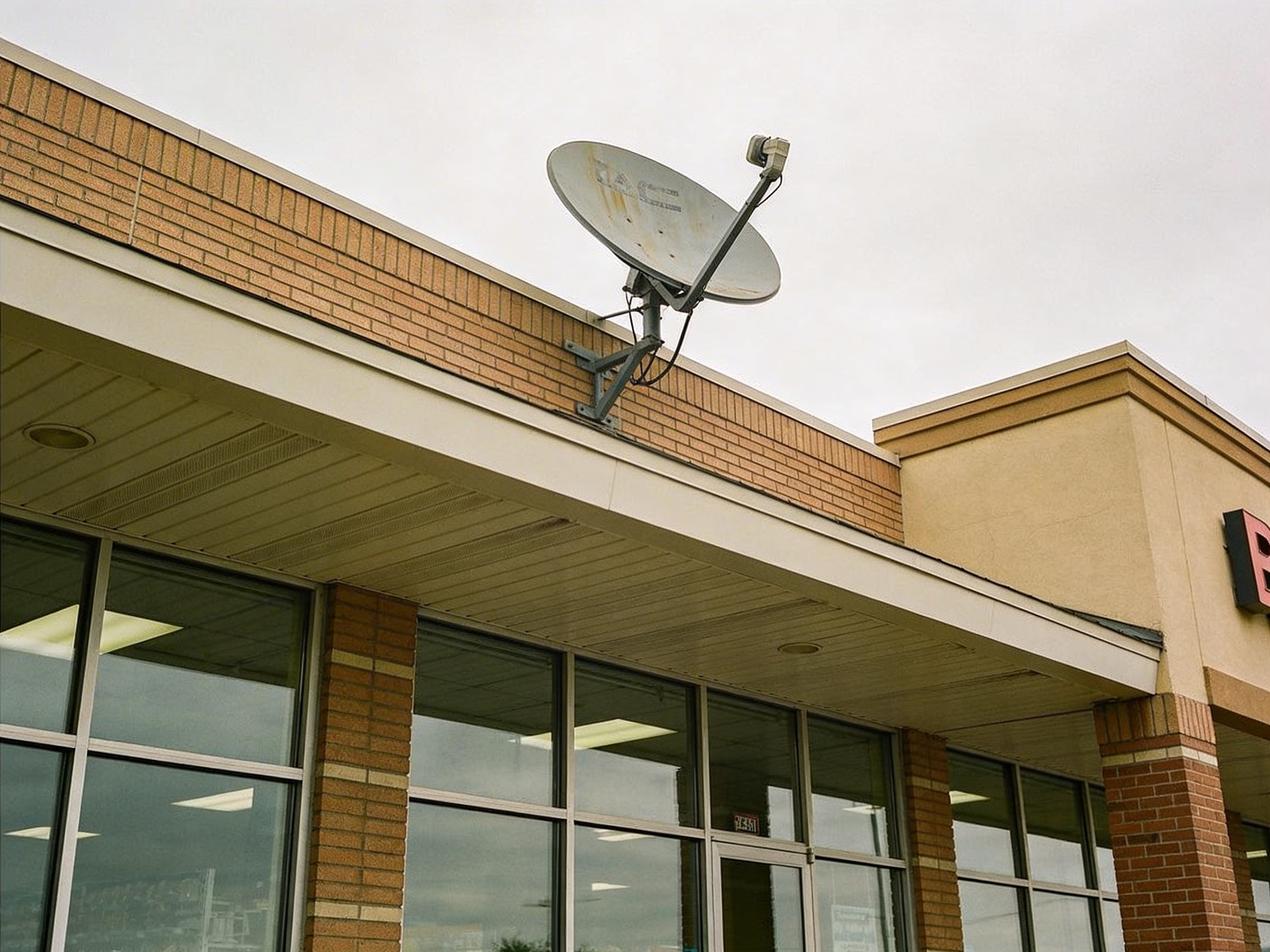
In the 1970s, Muzak uploaded its catalog to computers and launched its first broadcast satellite—making it the first satellite subscription radio service, decades before XM or Sirius existed. Distribution improved dramatically. Music could now reach thousands of locations simultaneously without physical media.
But the fundamental problem didn’t change. Satellite delivery meant wider reach, not more control. A retail chain with 50 locations still couldn’t customize what played in each store, adjust programming by daypart, or see whether the music was actually running in location #37. Headquarters chose a channel. Every store got that channel. If a player went down, nobody at corporate knew until someone in the field reported it—or didn’t.
Through the 1980s, Muzak continued to expand its satellite infrastructure and channel offerings. The distribution got better. The vendor model didn’t. Businesses were still locked into multi-year contracts, leased hardware they didn’t own, and a relationship that required account managers, service calls, and opaque pricing.
The Original Artist Disruption
While Muzak was expanding its satellite reach in the late 1960s and early 1970s, other companies recognized that businesses were tired of instrumental covers—they wanted to hear the actual songs customers knew from the radio. But delivering original artist recordings meant doing something Muzak had avoided: negotiating licensing deals with publishers and record labels.
In 1968, Seattle-based Yesco was founded specifically to offer licensed original artist music as a counter to Muzak’s instrumental approach. They used the “elevator music” stereotype against Muzak, offering soft-rock hits from major record companies arranged into workplace-appropriate playlists. In 1971, Audio Environments Inc. (AEI) launched with the same model—licensing and programming original artist music for businesses.
This was hard work. The licensing landscape was complex, deals had to be negotiated with multiple parties, and the business model had to support ongoing royalty payments. AEI and Yesco did that work. Muzak didn’t—until they started losing market share to these “foreground music” companies and had no choice.
By the mid-1980s, it was clear that businesses wanted to hear recognizable songs, not anonymous instrumental covers. Muzak launched “Foreground Music One” in 1985—their first original artist program—and merged with Yesco in 1986 to acquire the expertise and customer base they’d been competing against for nearly two decades.
The pattern that would repeat for the next 40 years was established: innovate elsewhere first, then Muzak follows or acquires.
Broadband internet did to retail music what it did to every other category of business operations: it made centralized, real-time control possible. Suddenly, a platform could push a playlist change to every location in a chain simultaneously. A dashboard could show what was playing in each store at that moment. Scheduling could be automated by daypart and season. Content could be stored locally on a player so that music continued even if the internet connection dropped.
This wasn’t just a technology upgrade. The internet opened the door for a fundamental shift in who controlled the music and how. For the first time, it was technically possible for the operations team at headquarters to manage retail music the same way they managed every other system in their stores—from a dashboard, on their own schedule, without calling a vendor.
The question was whether anyone would build a platform designed around that possibility.
The Internet Opened the Door for Real Control

The Internet Opened the Door for Real Control
Broadband internet did to retail music what it did to every other category of business operations: it made centralized, real-time control possible. Suddenly, a platform could push a playlist change to every location in a chain simultaneously. A dashboard could show what was playing in each store at that moment. Scheduling could be automated by daypart and season. Content could be stored locally on a player so that music continued even if the internet connection dropped.
This wasn’t just a technology upgrade. The internet opened the door for a fundamental shift in who controlled the music and how. For the first time, it was technically possible for the operations team at headquarters to manage retail music the same way they managed every other system in their stores—from a dashboard, on their own schedule, without calling a vendor.
The question was whether anyone would build a platform designed around that possibility.
Two Paths to the Same Market
The internet era produced two very different approaches to music delivery, and understanding where each one started explains a lot about how they work today.
What to Look For in Music for Retail Stores

How UMix Approaches Retail Music
UMix has served multi-location retail, restaurant, and hospitality businesses since 2009.
The platform was built from the ground up for operators who want centralized control without the overhead of the legacy vendor model. It includes a cloud dashboard for chain-wide management, dedicated hardware with built-in failover at each location, automated scheduling by daypart and season, and compliance logging for every song and message played. All explicit content is excluded from the catalog.
Pricing is published online. Terms are quarterly. Players cost $59 and are yours to keep. There are no multi-year contracts and no retention calls.